CO₂ & Tank Rentals
This guide covers the gas cylinders and tanks Brix Beverage rents to keep your fountain and beverage equipment running, how swaps and refills work, and how rentals are billed.
What CO₂ and tank rentals are
Your soda fountain, bag-in-box (BIB) system, and carbonator need a steady supply of food-grade carbon dioxide (CO₂) to carbonate water and push syrup through the lines. Rather than buying cylinders outright, most accounts rent them from Brix: you pay a recurring rental fee for the cylinder itself and get refills or full swaps as part of your service.
Some locations also use nitrogen or blended gas for specific dispensing setups. If you are not sure which gas your equipment uses, your delivery driver or a service technician can confirm it on site.
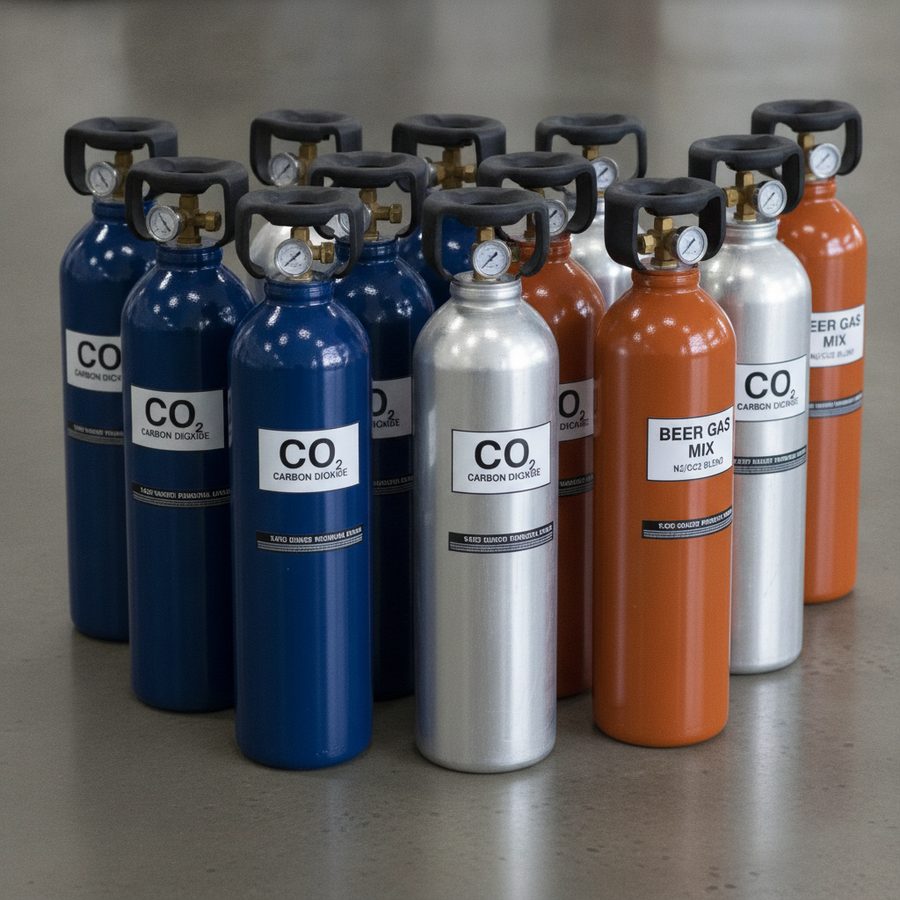
Common cylinder sizes
Cylinder sizing depends on your equipment and how much volume you pour. Typical options include:
- Smaller cylinders for low-volume counters or single-machine setups.
- Mid-size cylinders for a busy fountain or a couple of machines.
- Large cylinders or bulk tanks for high-volume locations.
We will recommend a size based on your usage so you are not running out mid-shift or paying for more capacity than you need. If your volume changes seasonally, we can adjust the cylinder size you keep on hand.
Swap and refill cadence
CO₂ is consumed as you pour, so cylinders need to be exchanged on a regular cadence. There is no single fixed schedule — it depends on your volume. Many accounts are on a recurring delivery route where the driver swaps empty cylinders for full ones on each visit. Higher-volume locations may need more frequent swaps; lower-volume locations less often.
A good practice is to keep at least one full backup cylinder on site so a run-out never interrupts service. If you find you are consistently running low between deliveries, let us know and we can increase your cadence or your cylinder size.
Safety basics
Compressed-gas cylinders are safe when handled correctly. A few essentials:
- Secure every cylinder upright with a chain, strap, or stand so it cannot
tip or fall.
- Store cylinders in a well-ventilated area, away from heat sources and out
of walkways.
- Never tamper with the valve or regulator. If a fitting is damaged or you
hear a leak (a hissing sound, or a sharp cold smell near the connection), shut the cylinder valve and contact us.
- CO₂ is heavier than air and can collect in enclosed spaces. If a storage
area feels stuffy or you feel lightheaded, ventilate the space before re-entering.
- Only trained staff should connect or disconnect cylinders. If you are unsure,
request a service visit rather than forcing a connection.
If you ever suspect a significant leak or smell gas in a confined space, prioritize getting people out and ventilating, then contact us.
How much soda does a 20 lb CO2 tank pour? (rule of thumb)
For fountain systems, plan on 1 lb of CO2 per 7-10 gallons of finished product. The theoretical yield is about 16 gallons per pound at 4 volumes of carbonation, but real-world losses — carbonator inefficiency, purging, and CO2 used to push syrup — cut that roughly in half.
That means a 20 lb tank yields about 140-200 gallons of soda. A 3-gallon BIB makes about 18 gallons of finished product at a 5:1 mix, so a 20 lb tank pours roughly 8-11 three-gallon BIBs — use ~10 as the safe planning number.
Big swing factors:
- CO2-driven syrup pumps — if your CO2 also powers the pumps, plan toward
the low end (~8 BIBs per tank).
- Water temperature at the carbonator — warmer water absorbs less CO2, so
more gas is wasted.
- System leaks — a slow leak can easily cut a tank's yield in half. If
you're going through tanks faster than about 1 per 8 BIBs, ask us to leak- check the system.
How to request a swap or extra cylinder
You can request a cylinder swap, an extra backup cylinder, or a size change a few ways:
- Call us and we will route it to the right team.
- Mention it to your delivery driver on their next visit.
- Call or email the support team if it is urgent.
When you request a swap, it helps to note your location, the cylinder size, and whether you need a routine exchange or an emergency delivery because you have run out.
Billing for rentals
Cylinder and tank rentals are billed on a recurring basis as part of your account — typically a per-cylinder rental charge that appears on your regular invoice. The gas itself (refills/exchanges) may be billed per swap or rolled into your service plan, depending on your agreement.
Rental charges appear on your invoices. If a rental charge looks wrong — for example, you are being billed for a cylinder you returned — open a service request or contact support and we will reconcile it. For questions about setting recurring rental payments on autopay, see the account & billing guide.
Tank audits and missing cylinders
Rented cylinders stay Brix property, and our records track how many are at your location by type (you can see the count any time on your Cylinders page). Periodically a Brix driver performs a Tank Rental Audit: they count every cylinder on site — full and empty — photograph them, and ask for a signature. If the count differs from our records, a $0 adjustment invoice (document number starting CR-ADJ) trues up the books, and the audit record is attached to that invoice in your.
If our records and your tanks don't agree, your next delivery includes an audit. You'll see a notice until it's done, and the driver's job carries the same instruction. Please have all cylinders accessible for the count, including empties.
Lost or unreturned cylinders are billed at the replacement rate of $165 per cylinder. When an audit confirms cylinders are missing, the replacement charge appears on a separate invoice (document number starting CR-LOST) after a Brix manager has reviewed the audit. If a cylinder turns up afterwards, contact support with the invoice number and we'll sort it out.
Still not pouring right?
Our technicians cover the whole Bay Area — most service calls are handled within 24–48 hours.