
CO₂ System Troubleshooting & Safety
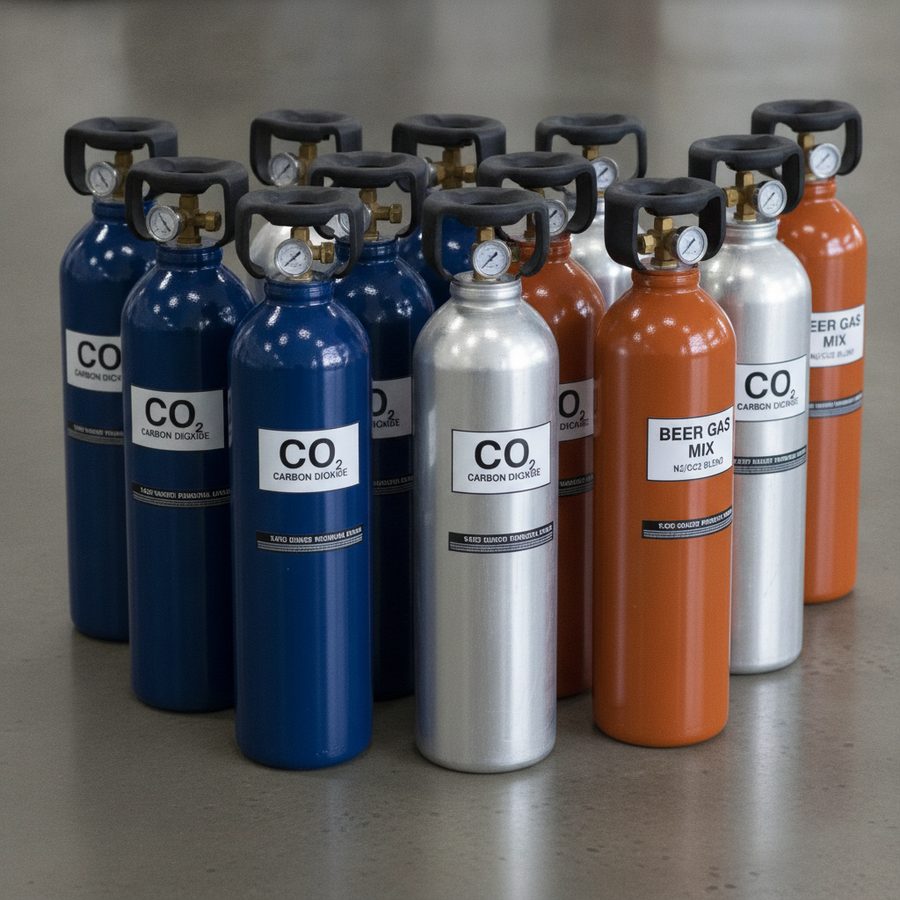
This guide covers the CO₂ side of your beverage system — the cylinder, regulator, and gas lines that carbonate your soda water and (on many setups) power your syrup pumps. For rental sizes, swap cadence, and billing, see the CO₂ & tank rentals guide; for what a tank yields, the 20 lb rule of thumb lives there too.
CO₂ is safe when handled correctly, but it displaces oxygen and is heavier than air. If you ever hear a loud continuous leak in an enclosed space, or anyone feels dizzy or short of breath near the gas storage area, get people out and ventilate first — then call us. Never troubleshoot in an enclosed space that feels stuffy.
How the CO₂ system fits together
- Cylinder — the rented tank of beverage-grade CO₂, secured upright.
Only beverage-grade CO₂ belongs in a drink system — never welding, medical, or generic food-grade gas. Every cylinder we supply is beverage-grade; never refill from another source.
- Primary regulator — mounts on the cylinder valve and steps the very high
tank pressure down to the working pressure your system needs. Most have two gauges: one showing tank contents, one showing the outgoing line pressure.
- Secondary regulators (some systems) — split and fine-tune pressure for
different circuits, e.g. one pressure for the carbonator and a lower one for gas-driven syrup pumps.
- Carbonator — mixes CO₂ into chilled water; feeds the soda side.
- Syrup pumps (gas-driven setups) — use CO₂ pressure to push syrup from
the BIBs to the dispenser.
The correct pressures for your system are set at install and posted on your CO₂ tank status tags — go by the tag. As reference points from our quality standard: the carbonator-side regulator typically runs 95–105 psi, and the syrup-rack gauge is typically set at 45 psi. Different circuits intentionally run at different pressures, so never "even them out" or copy a number from one gauge to another, and leave adjustments to a technician.
Reading the gauges
- Tank/contents gauge: because CO₂ is stored as liquid, this gauge reads
nearly full right up until the tank is almost empty, then drops fast. Do not use it to plan swaps — weight or your usage cadence is more reliable.
- Line-pressure gauge: with the cylinder valve open, it should sit at the
marked working pressure and hold steady. Reading zero with a full open cylinder, drifting, or creeping upward all mean the regulator needs service.
Suspected gas leak
A leak wastes gas (tanks emptying much faster than usual is the classic sign) and, in an enclosed space, can be a safety issue.
- Listen and feel around the cylinder valve, regulator, and fittings for
hissing or a sharp cold spot.
- Soap test: mix a little dish soap in water, brush it on the fittings
and connections, and watch for growing bubbles — that is your leak.
- Hand-tighten a loose connection if it is a simple hand fitting; do not
wrench on regulator parts or the cylinder valve.
- If the leak is at the valve, the regulator body, or will not stop: shut
the cylinder valve, ventilate the area, and submit an urgent service request or call us.
- Going through tanks unusually fast with no audible leak? Ask us to
leak-check the system — a slow leak can cut a tank's yield in half.
Regulator problems
- Pressure will not hold (drops while pouring, creeps back up, or drifts
day to day): the regulator needs service. Note what the gauge does and file a request.
- Frost or heavy condensation on the regulator or lines during heavy
pouring can happen when a lot of gas moves quickly; constant icing, or icing during normal use, means the draw is too high for the setup or something is stuck open — request service.
- Never disassemble or adjust internals. The adjustment screw on some
regulators changes your system's working pressure — leave it at the marked setting unless a technician directs otherwise.
Ran out of gas
- Close the empty cylinder's valve.
- If you are trained to do so, move the regulator to your full backup
cylinder, open its valve, and confirm the line gauge returns to the marked pressure. Use a new washer/seal if your fitting requires one.
- Pour to confirm carbonation is back and (on gas-driven setups) the syrup
pumps run.
- Request a swap right away so you are never without a backup on site.
If you have no backup, submit an urgent service request or call — note that you are fully out so it gets routed as a run-out.
Storage and handling rules
- Secure every cylinder upright with a chain, strap, or stand — full or
empty.
- Keep cylinders in a ventilated area away from heat and out of walkways.
- Keep the valve closed on cylinders not in use.
- Move cylinders by tilting and rolling on the base edge or with a cart —
never drag, drop, or carry by the valve.
- Leave valve or regulator repairs to us: if a fitting is damaged, take that
cylinder out of service and tell us at the next swap.
When to call for service
Call or file an urgent request immediately for: a leak you cannot stop by closing the valve, any leak in an enclosed space, or a damaged valve. File a normal service request for: a regulator that will not hold pressure, tanks emptying faster than your usage explains, frost during normal operation, or any pressure adjustment — and tell us what the gauges read. The assistant can file the service call for you if you describe the problem.
Still not pouring right?
Our technicians cover the whole Bay Area — most service calls are handled within 24–48 hours.